When Do Baby Garter Snakes Hatch in Colorado
Garter Ophidian Facts
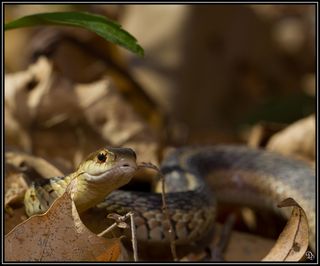
Garter snakes are among the most mutual snakes in North America, with a range spanning from Canada to Florida. Oft kept as pets, they are relatively harmless, although some species do possess a balmy neurotoxic venom. Yet, it is not dangerous to humans.
Where did the garter snake become its funny name? According to Doug Wechsler, a wildlife biologist at the Academy of Natural Sciences of Drexel University in Philadelphia and writer of "Garter Snakes" (Powerkids, 2001), their stripes resemble garters men used to wear to concur up their socks. Another theory is that information technology is a abuse of the German word for "garden." Garter snakes are sometimes erroneously called "garden snakes."
Physical characteristics
Garter snakes come in a wide variety of colors depending on the species, only "most accept 3 longitudinal stripes — i in the center of the back and ane on each lower side of the body," according to herpetologist Jeff Beane, collections manager of amphibians and reptiles at the N Carolina Museum of Natural Sciences. "In most species, the stripes are yellowish or green, merely this varies with species and region."
Some garter snakes have intricate splotchy patterns betwixt their stripes, making them look checkered. And their appearance really does depend on the species — Beane pointed out that some garter snakes are "nigh stripeless."
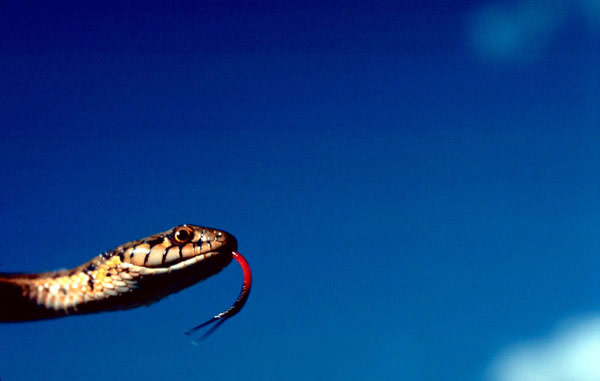
Garter snakes are relatively pocket-sized, normally between 23 and 30 inches (58 and 76 centimeters), though sometimes growing as long every bit five feet (1.5 meters). Beane described them as "slender to moderately stout-bodied ... [with scales that are] manifestly keeled," meaning they accept a ridge down the center. He added that many species of garter snakes take two-colored tongues.
Habitat
Beane described garter snakes as "generalists, inhabiting a wide variety of habitats." They live in woodlands, meadows and grassy knolls and like to be near water, especially "in the arid parts of the West," Beane said.
The common garter ophidian occurs throughout N America, from the Atlantic Ocean to the Pacific Ocean and into southern Canada, co-ordinate to the Virtual Nature Trail at Pennsylvania State University New Kensington.
The garter snake is arable in the eastern Usa; it is the country reptile of Massachusetts.While no snakes are known to be native of Alaska, a road-killed specimen of a garter ophidian was constitute near Haines, Alaska, in 2005, according to an article in the Journal of Herpetology. Researchers who identified the serpent through mitochondrial DNA concluded that the single ophidian represented a relict, or remnant, population, a contempo natural colonization or a fresh introduction.
Habits
Garter snakes are mostly active during the day. Beane described them as "relatively fast-moving [and] highly terrestrial, but [some] may climb into shrubs or vines; some species climb more than others." Wildscreen'southward ARKive Initiative pointed out that some species are as well excellent swimmers.
When threatened, garter snakes give off a bad-smelling musk. Because of their modest size, garter snakes take many predators, including hawks, crows, bears, bullfrogs, snapping turtles, foxes, squirrels and raccoons, according to the Creature Diversity Web (ADW), a database maintained by the University of Michigan's Museum of Zoology.
Cold-climate garter snakes hide during the winter. They hibernate in dens in large groups, with hundreds of garter snakes sometimes found together (and sometimes other serpent species, co-ordinate to Beane). According to the Virtual Nature Trail, one den in Canada was the hibernation spot of more 8,000 snakes. Garter snakes volition travel long distances to a communal den for hibernation, according to the ADW.
Nutrition
Beane said that garter snakes "feed by and large on fishes, amphibians, and earthworms; other prey are occasionally taken." The snakes immobilize their prey with their precipitous teeth and quick reflexes. The saliva of some species contains a mild neurotoxin that causes paralysis, making small-scale prey easier to consume. Like other snakes, garter snakes swallow their food whole, co-ordinate to the ADW. Beane said "some larger prey may be dragged and chewed until killed by trauma."
Seize with teeth
While almost species are classified every bit harmless (non-venomous), their bite can cause small swelling or itching in humans, and anyone bitten by a garter snake should make clean the bite thoroughly. It is not ultimately a cause for business organisation. Allergic reactions to the saliva have been known, but cases are extremely rare, co-ordinate to the ADW.
Reproduction
According to Beane, the all-time situations for mating are "when they emerge [from hibernation] in the spring and besides when they besiege again in autumn ... because they are already gathered together for hibernation and do non take to waste energy seeking mates." But for garter snakes in more temperate areas where they don't hide, the snakes rely on pheromones.
Female garter snakes give off pheromones to concenter males. Dozens of males will come to one female, which is why homeowners sometimes recollect garter snakes are overrunning their neighborhoods. According to the biology department at Reed College, this mass of mating snakes is called a "mating brawl."
Some males utilize trickery to confuse their competition, co-ordinate to Reed College. They volition secrete female pheromones to lure other males toward them rather than to the female. Afterward the other males are abroad from the mating ball, the males posing every bit females will dart dorsum to the female to attempt to mate. [Related: Estrogen Turns Male Snakes Into Same-Sex activity Charmers]
Garter snakes are ovoviviparous, meaning they bear live immature. After mating, females store sperm in their bodies until they desire to fertilize their eggs. Garter snakes requite nascency to 20 to 40 alive young at a time, though Beane pointed out that litter sizes can vary greatly. "As few equally five and as many equally 101 have been reported," he said. Parent snakes exercise non care for their young.
Taxonomy/classification
In that location are xxx species of garter snakes and many more subspecies, according to the Integrated Taxonomic Information System. The taxonomy of garter snakes is:
Kingdom: Animalia Subkingdom: Bilateria Infrakingdom: Deuterostomia Phylum: Chordata Subphylum: Vertebrata Infraphylum: Gnathostomata Superclass: Tetrapoda Class: Reptilia Social club: Squamata Suborder: Serpentes Infraorder: Alethinophidia Family: Colubridae Subfamily: Natricinae Genus: Thamnophis
Species: xxx, including:
Thamnophis sirtalis (common garter snake): The common garter snake has the largest range, occurring in most of the continental United states with several subspecies, according to Beane. They are found everywhere from Alaska to Florida, though they do non alive in the Southwest. Common garter snakes usually have 3 white, yellow, blue, or green stripes running the lengths of their brown or olive bodies. Their heads are darker than their bodies.
Thamnophis sirtalis sirtalis (Eastern garter snake): This subspecies of common garter snake is typical throughout the eastern United States. Though its body color may vary from brownish to dark-green, it almost always has three xanthous stripes on its back, co-ordinate to the Savannah River Ecology Laboratory. Sometimes its torso is splotchy, giving it a checked appearance. Eastern garter snakes in Georgia and Florida sometimes have bluish coloring.
Thamnophis sirtalis parietalis (red-sided garter serpent): This California subspecies of common garter snake can be stunning. Blue or yellow stripes popular against the nighttime olive or black body, and scarlet bars line the sides of the body. The carmine-sided garter snake has a scarlet or orange head and a blue underside. North of the San Francisco Bay Area, the underside is sometimes a bright bright blue. Its eyes are larger than other garter snake species. According to California Herps, it is able to eat Pacific newts, which are poisonous to other predators.
Thamnophis sirtalis tetrataenia (San Francisco garter snake):According to California Herps, this San Francisco peninsula snake has a red head, big eyes, and wide, blue-green, black, and carmine stripes. Its underside is blue-green. Like the ruby-red-sided garter snake, it eats Pacific newts.
Thamnophis marcianus (Checkered garter serpent): This modest, southwestern snake has a nighttime checkered blueprint over its entire trunk, plus three thin light-colored stripes, according to Herps of Texas. It is rarely longer than ii feet.
Thamnophis sirtalis annectens (Texas garter snake): This common garter serpent subspecies primarily resides in the Alone Star State, though according to Wildlife N America, there is a population in Kansas. It has a dark colored back with a brilliant cherry-red stripe down its eye and two light-colored stripes on its sides.
Conservation status
The International Union for the Conservation of Nature's Red List of Threatened Species lists common garter snakes as "least business concern" for threat of extinction, noting their wide range and population size, estimated to be more 1 million adults in the wild.
The U.South. Fish and Wildlife Service lists the San Francisco garter snake is listed as "endangered" because it is threatened by habitat loss and over-collection.
Additional resources
- Canadian Geographic: Facts nearly the common garter serpent
- Animate being Diversity Web: Thamnophis sirtalis
- Virtual Nature Trail: Common garter snake
Source: https://www.livescience.com/44072-garter-snake.html
0 Response to "When Do Baby Garter Snakes Hatch in Colorado"
Post a Comment